Ice2Thrust

Solar-Electric Water Propulsion System

European EIC Pathfinder Project Lead Research Scientist - RL-based Autonomous Navigation

Project Overview

ICE2THRUST concept

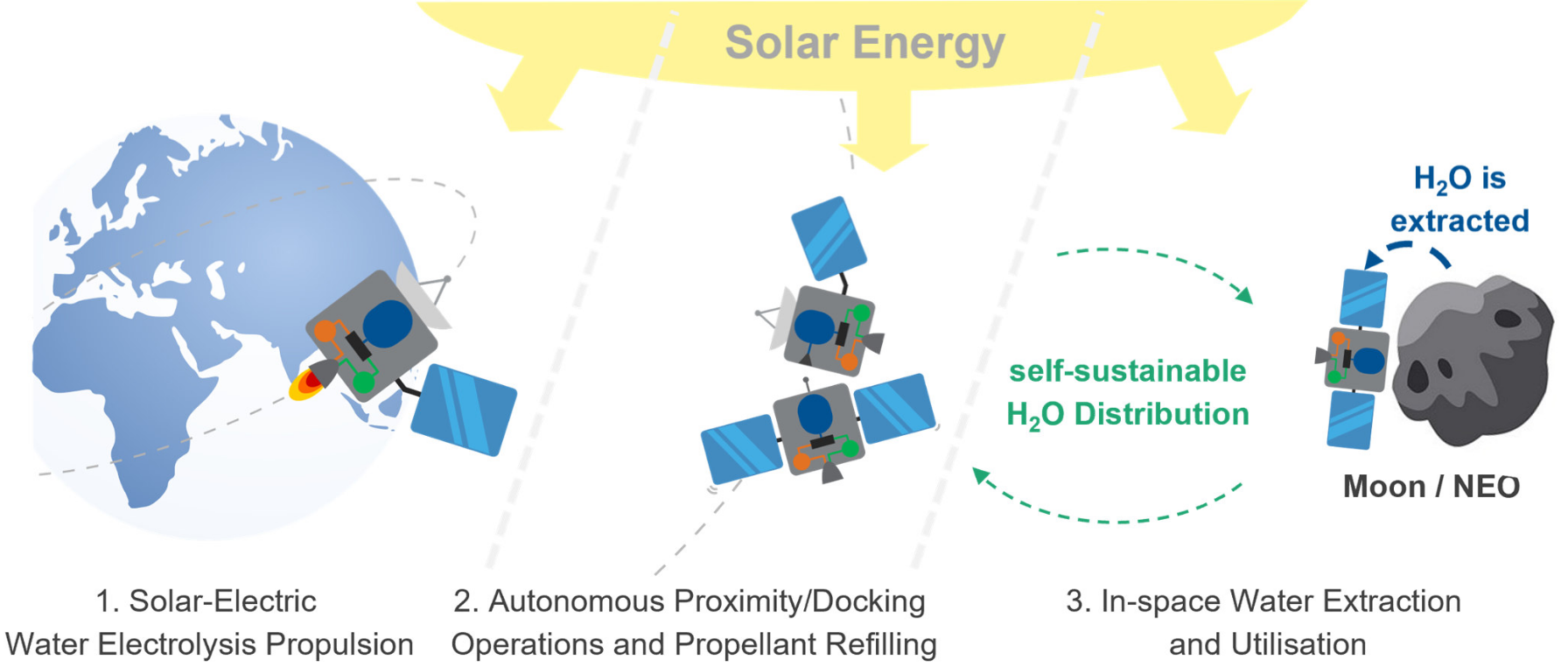
ICE2THRUST represents a groundbreaking approach to space propulsion, developing the world's first In-Situ Resource Utilisation (ISRU) end-to-end process chain that transforms ice into thrust. This innovative system utilizes water as a propellant, decomposed by an electrolyser into hydrogen and oxygen for subsequent use in a thruster.

As Lead Research Scientist for RL-based autonomous navigation systems, I'm responsible for developing the intelligent control algorithms that enable autonomous proximity operations, docking, and propellant refilling procedures.

Technical Approach

🚀 Solar-Electric Water Electrolysis Propulsion

Development of high-efficiency propulsion systems using water as propellant, achieving the highest specific impulse of all storable chemical propulsion systems.

🤖 Autonomous Proximity Operations

RL-based algorithms for autonomous docking, proximity operations, and propellant refilling procedures with machine learning-enhanced decision making.

⛏️ In-Space Resource Utilization

Advanced systems for water extraction from icy regolith and integration with propulsion systems for self-sustainable space operations.

My Research Contributions

Simulation Framework Development

  • Modular spacecraft simulators: Designed and built modular 3DoF and 6DoF spacecraft dynamics simulators for proximity operations, covering a range of parametrizable satellite configurations and mission profiles.
  • Proximity operations scenarios: Developed simulation scenarios covering approach, station-keeping, docking, and propellant refilling operations under realistic disturbances and uncertainty.
  • Scalable environment design: Built the simulation infrastructure to support large-scale parallel training of deep RL policies using IsaacLab/Omniverse.

Autonomous Navigation and Control

  • Deep RL policies for rendezvous: Designed and trained deep RL policies for robust autonomous rendezvous and docking under uncertainty, including unknown mass properties and thruster noise.
  • Hardware-in-the-Loop validation: Integrated trained controllers into Zero-G floating-platform Hardware-in-the-Loop (HIL) setups to study and validate sim-to-real transfer.
  • Sim-to-real transfer: Developed and evaluated domain randomization and adaptation strategies to bridge the gap between simulation and the physical floating platform testbed.

Project Resources

← Back to Portfolio Next Project: AIRSHIP →